


Colouring Books for Nursery and School: A Practical Guide
How to use colouring pages in kindergarten and school: choosing designs, A4 print tips and classroom ideas.

Teachers in nurseries and primary schools often look for fast printing: something that children aged 3 to 8 can do, fits on an A4 sheet, and means you don’t have to buy expensive workbooks. Colouring books for nursery and school They are just the sort of aid – cheap, flexible and much loved by children.
This guide is written for teachers, childcare workers and parents. In it, you’ll find out why colouring sheets work in a group setting, how to choose a theme based on age and subject, five specific ways to use them in the classroom, tips on printing 15–25 copies, and answers to frequently asked questions. You can download the finished drawings for free in the category For nurseries and schools.
Why colouring books work in nursery and school
Colouring books aren’t „just about colouring“. They serve several purposes in the classroom: they help children practise fine motor skills (crayon grip, pressure, line control) help the child to stay focused on a single task for 10–20 minutes and reduce tension within the group after a physical activity or before a meal. When covering topics such as autumn, animals, numbers, Halloween or summer, you can easily link the same worksheet to Topic of the Month – without having to draw 20 copies by hand.
Unlike freehand drawing, colouring books have clear outlines. This is particularly helpful for pre-schoolers who are not yet able to draw more complex shapes on their own. Even those who are not so good at drawing end up with a finished piece that they are happy to display on the noticeboard. In practice, at nursery, it is usually enough to one sheet a day; they’re more useful on a rainy day or during free play in the play corner. They work better as an optional activity than as a compulsory task with no choice: those who want to can colour in; those who don’t can do a jigsaw puzzle.


How to choose a theme for the classroom
The choice of theme determines whether the children will stick with it and whether the classroom will be calm or descend into frustrated chaos. There’s a simple rule: the younger the group, the fewer details and the thicker the lines.
Large areas, thick lines
The following are suitable for nursery school (ages 3–6) simple motifs: a sun, a piece of fruit, an animal, a tree. Avoid fine details, hatching and dense anti-stress patterns – when printed on A4 paper in 15–20 copies, these can frustrate children, and fine lines tend to disappear on a standard printer. You’ll find the final selection in the category For nurseries and schools. For the very youngest, ideal options include, for example, sunshine or a selection from simple motifs.
Relevance to the theme of the week
A colouring book is most useful when it ties in with what you’re talking about at the moment. For autumn, print out autumn tree. When it comes to animals, you’ll reach for to the hedgehog or by a broader category Animals. When teaching numbers and shapes, use educational colouring books – for example numbers 1 to 5 or a circle, a square and a triangle. After talking about summer or the sea, a theme from Summer category; after Halloween, you’ll reach for Halloween colouring books.
One theme for the whole group
It’s better to give all the children one identical image. There’s less chaos when handing out the pieces, it’s easier to compare progress, and the result looks like a shared gallery on a noticeboard. Five- to six-year-olds can already manage a simple scene – for example, children at nursery, a hedgehog or an autumn tree. Primary school pupils starting Year 1 will appreciate the worksheets and simple mazes. For more detailed information by age group, see the article how to choose a colouring book based on the child’s age.
Things best to avoid: overly complicated anti-stress patterns (children tend to give up), licensed characters (unless you want to have to deal with their parents), and designs with lots of tiny dots – these often get lost in bulk printing.
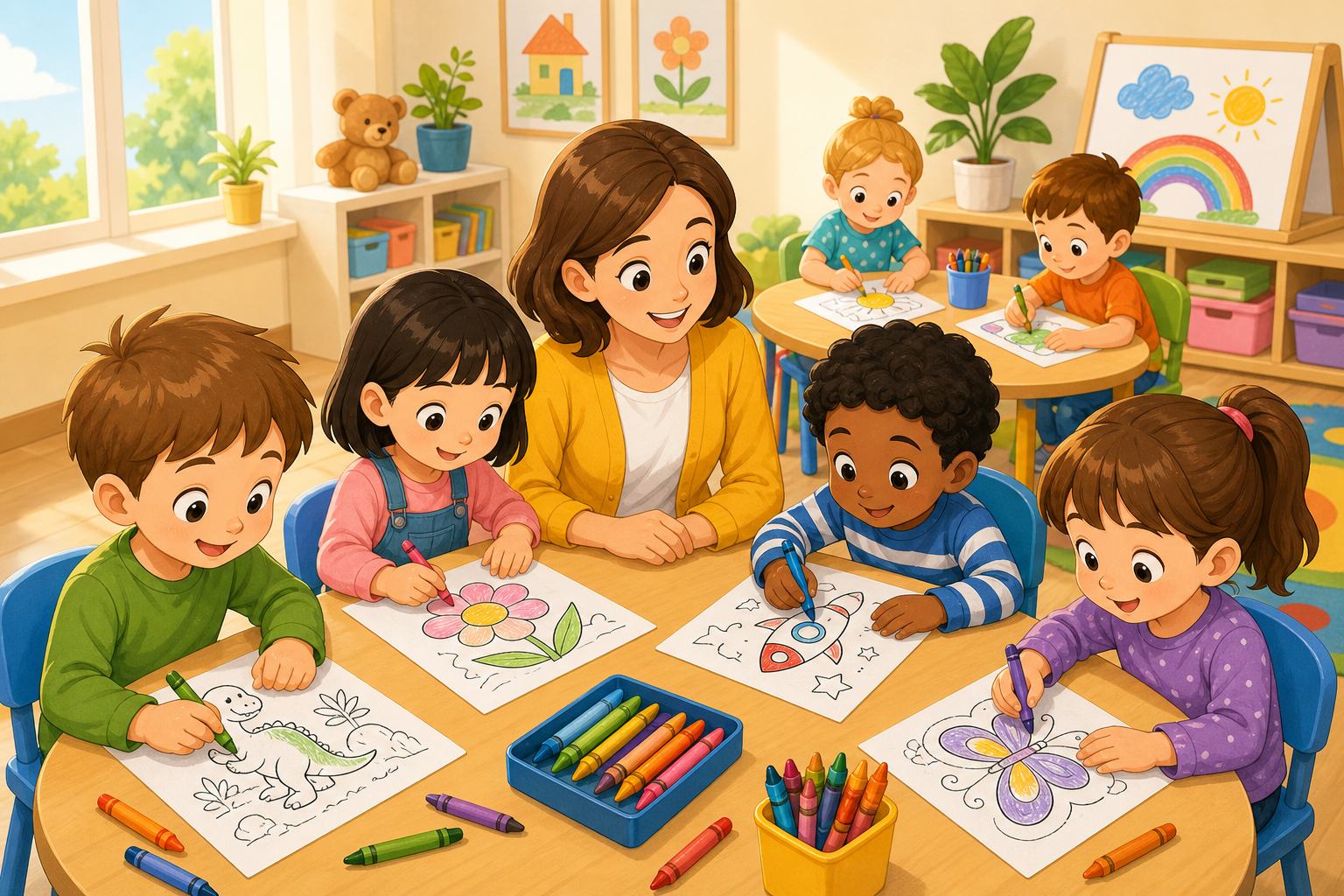
How to use colouring books in the classroom
Simply choosing a theme is not enough – what matters is, when and as Give the children some paper. Below are some tried-and-tested scenarios that work most often in nurseries and primary schools.
An early arrival and quiet pre-race activity
As the children arrive one by one, they find crayons and a printed sheet on the table. They can start straight away and don’t have to wait for everyone to arrive. Simple designs are ideal, such as sunshine or fruit. Meanwhile, the teacher welcomes the parents and sorts out organisational matters – the class is now settled.
A supplement to the topic of the month and relaxation after exercise
After a story, a song or a short film, give the children 15 minutes to colour in a related picture. After running about in the playground or a PE lesson, this works just as well as a bridge to the next activity: tension eases and the children are able to listen. It can also be combined with a playful task – first a maze or connecting the dots from Fun activities, then colours. Example: football maze – first the path, then colouring in the surroundings.
Homework „for fun“
A letter home at the weekend: „Colour this in and bring it in to show your friends.“ No marks, just praise for trying. Parents will appreciate not having to buy anything – everything is provided colouringbookspredeti.eu for free. You can then organise a mini exhibition at the nursery: each sheet of paper on a string or on the noticeboard.
Printing tips (A4, 15–25 copies)
When it comes to bulk printing, practicality is key. Print black and white A4 – they save on toner and let your child choose the colours themselves. A draft print is fine for test prints; print the final copies in standard quality. Stick to printing on one side of the paper: double-sided printing often causes the colours to run when using felt-tip pens. On Monday, you can prepare a set of five designs for the whole week and then simply hand them out. You don’t need a colour printer – the colouring pages are deliberately in black and white. If you don’t have a printer at all, try online painting. More about formats: Guide to free printable colouring pages.
A typical week at nursery
If you don’t want to start from scratch every day, a simple framework is all you need. Vary the motifs according to the theme of the month:
- Monday: early arrival – sunshine or fruit
- Tuesday: Topic of the week – e.g. hedgehog / autumn tree
- Wednesday: after movement – children at nursery
- Thursday: educational – numbers 1–5 or shapes
- Friday: a playful activity + colours – e.g. maze and then the colouring
At the end of the week, display the finished work on the noticeboard. The children can see the collective result, and the parents have something to talk about when they leave. Other ideas for outside the classroom: holiday activities or A rainy day with colouring pages.
Frequently Asked Questions from Practice
How many colouring pages a day are enough?
In nursery, it’s usually one sheet (10–20 minutes). On a rainy day or during free play in the play corner, you can prepare a second design – not as a compulsory task, but as an option. More important than the number is whether the child manages to finish the sheet without feeling stressed.
Should colouring books be compulsory?
Better than an open-ended activity. An obligation without a choice often takes the fun out of it. If a child doesn’t want to colour, let them do another quiet activity – a jigsaw, a book or a building set. The aim isn’t to „produce 20 identical pictures“, but to give children a peaceful, creative moment.
Are the colouring pages on this website really free?
Yes – both printing and online colouring are free of charge. Just open For nurseries and schools and download. You can add educational themes or playful tasks.
What if I don’t have a colour printer in my classroom?
Never mind. The colouring pages are black and white on purpose – children add the colours themselves using crayons or felt-tip pens. Colour printing would actually limit their scope for creativity.
Colouring books for nursery and school They save time for both teachers and parents: quick to print, clear activities and results that children love to show off. Start with the ‘For Nurseries and Schools’ category, add some educational themes or fun activities, and you’ve got a plan for the whole week.